If you click on any images in the blog, it will be opened in a separate window, will be larger and it will be easier to see detail.

Blog posts after 1 Feb 2018 about Steppe eagles tracked from Oman can be found at the Steppe eagle blog

Sunday, March 13, 2022

Supplementary material for McGrady et al. In press. Sandgrouse 44.

These figures provide supplementary information about an Egyptian Vulture (Neophron percnopterus) tracked as it transitioned during 2018 - 2020 from being a floating individual in Oman and Iran to an apparent territory holder in Iran.  The published account of the movements of that bird is:

McGrady, MJ, Schmidt, M, Elahi Rad, Z & Meyburg, B-U. In press. Tracking of an Egyptian Vulture Neophron percnopterus as it transitions from being a floater to being a territory-holder.  Sandgrouse 44: xxx - xxx. 

Ornithological Society of the Middle East: https://osme.org/
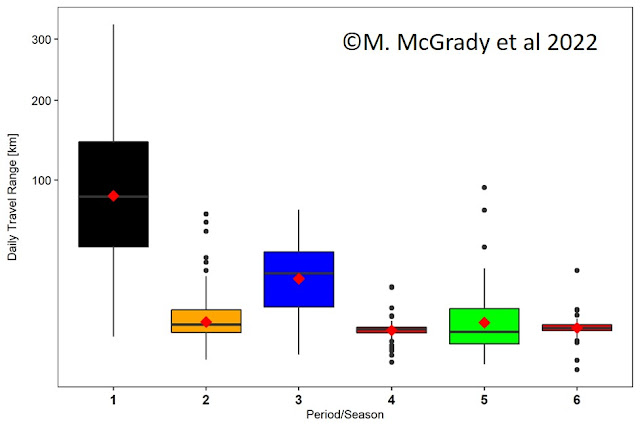

Supplementary Figure 1. Box plot of daily travel range of an Egyptian Vulture tracked in Oman and Iran during six purported periods of floating, acquiring a territory and breeding, 20 January 2018 – 30 March 2020. 1 - Floating in Oman and Iran, 2 - Pre-recruitment, 3 - Prospecting for territory, 4 - Breeding, territory holding 2019, 5 - Non-breeding, territory holding, 6 - Breeding season 2020 (partial). Boxes = 2nd and 3rd quartile, red diamond=mean, line in box=median, whiskers=approx 95% confidence intervals, black dot=outliers.


Thursday, September 10, 2020

Home range of an Egyptian vulture in Oman

by M. McGrady and B.-U Meyburg

This is a little movie of the movements of an Egyptian vulture we tracked in Oman.  The video covers about 2 years of movements.  The territory is in the eastern part of the home range and the Muscat municipal landfill at Al Multaquaa is in the west.  The movie shows the regular visits this bird makes to the landfill.

Thanks Matthias Schmidt for animating the data.


Friday, July 17, 2020

171329 during early summer 2020

by B.-U. Meyburg and M. McGrady

We are still tracking a few Egyptian vultures that we fitted with satellite transmitters back in January 2018.  All, except one, stayed in Oman, and most seemed to be breeders.  The one that moved, just hopped across to Iran and settled there (but was recently electrocuted).  See past posts.

Below is an interesting map from 171329, which illustrates some common features we are seeing in vulture ranging behaviour.  In this map you can see that this bird moves mostly between Wadi Sareen (where it might breed and roost), and locations near Bidbid and at the Muscat landfill at Al Multaqaa (click on the map and it should open in a seperate tab).  However, it also makes exursions to Al Hayema and even to Al Mudaybi (almost 80 km away as the vulture flies).  Interestingly, at Al Mudaybi it visited a waste disposal site.  These movements are consistent with our supposition that the vultures sometimes venture to distant locations, perhaps to keep up to date on information about food availability.

Movements of an Egyptian vulture during early summer 2020.

171318 electrocuted

by M. McGrady and B.-U Meyburg

First of all... apologies for not posting anything for so long. 

Some bad news... On 22 April 171318 stopped moving, meaning either the bird had died or it had dropped its tag.  We notified colleagues in Iran, who quickly went out in search of the bird, and found it.  It had been electrocuted.  Below are some pictures.

Electrocution is a big probem for large soaring birds in many parts of the world.  At least two of the Egyptian vultures we have tracked from Oman in recent years have died in this manner. http://migratorysoaringbirds.undp.birdlife.org/en/sectors/energy/electrical-power-lines-toc#gsc.tab=0

Although this is bad news, it was very encouraging to receive such fast and effective help from our Iranian colleagues.  They responded within a very short time.  They have been also helpful in finding downed tags of Steppe eagles and Greater spotted eagles. 


Just to remind you... 171318 was fitted with a transmitter near Muscat in January 2018.  It flew back and forth along the north Oman coast, then across to Iran in April 2018.  It settled in around Qeshm Island, but apparently did not breed in 2018.  In 2019, it moved inland and seemed to occupy a territory and may have bred.  See the maps below and look back at earlier posts for details.

Movements of Egyptian vulture 171318 during Jan-May 2018.
Movements of Egyptian vulture 171318 during 1 Jan -22 Apr 2020.


Monday, March 9, 2020

Egyptian vultures in Oman are breeding

by B. U.Meyburg & M. McGrady


We are continuing to track Egyptian vultures in Oman. Most, if not all, the birds we are tracking are territory holders, and some of those may have already laid eggs. We can tell this by the reduction in solar power being created by the panels that power the transmitters.  This is because tagged birds are spending more time on the nest (in the shade) than when they are not breeding.  

An important finding of our work has been that Oman appears to be a stronghold for this globally endangered species.  Follow this link https://bioone.org/journals/Ardea/volume-108/issue-1/arde.v108i1.a4/A-Globally-Important-Stronghold-in-Oman-for-a-Resident-Population/10.5253/arde.v108i1.a4.full to download our Open Access article, and pass it on to others that might be interested.

Because breeding Egyptian vultures are now spending more time on their territories the numbers being seen at Al Multaqaa landfill will be lower than during the winter.  Additionally, migrating eagles (Steppe eagles, Imperial eagles, Greater spotted eagles) will also depart soon, if they have not already done so.

During February we also conducted field work in Djibouti on Egyptian vultures.  Djibouti may also be a stronghold.  You can follow that effort here: https://egyptianvulturedjibouti.blogspot.com/

So as not to deprive you of some eye-candy, below is a map of the movements of one of our territorial Egyptian vultures during one day in early March.  One can see how it spent most of its time near its presumed breeding territory, but made a trip north the Al Multaqaa... presumably to feed.

Movements of a territorial Egyptian vulture durin 2-3 March.  The shaded area is Wadi Sireen Nature Reserve


Monday, January 6, 2020

Egyptian vulture work in Oman - a history

by M. McGrady and B.U. Meyburg

An adult Egyptian vulture ready to be fitted with a satellite tag in 2018.

Egyptian vulture is globally endangered, and faces a wide range of threats including, poisoning, electrocution, persecution and hunting for belief-based medicine.  Most vulture species in Eurasia and Africa are of conservation concern, being either endangered or critically endangered.

Since 2012 Egyptian vulture research has been conducted in Oman.

2012 - surveys of breeding Egyptian vultures on Masirah supported by the Environment Society of Oman (ESO) find it to be the second most dense population in the world,  The result of that survey are published.

2013 - Waheed Al Fazari conducts vulture surveys for 1.5 yrs at the Muscat municipal landfill. Results are published.

2014 - the ESO supports wider surveys at dumpsites on the mainland.

2015 - Waheed Al Fazari and International Avian Research capture and tag with a satellite transmitter the first Egyptian two vultures to be tracked in Oman

2016 - two more vultures fitted with satellite transmitters by International Avian Research

2018 - 12 adult Egyptian vultures are trapped at the Muscat municipal landfill and fitted with transmitters.  This work funded by International Avian Research and the Bernd Meyburg Fund for Raptor Conservation and Research.  Be'ah, the waste management company in Oman, joins the conversation about how best to manage waste in Oman to benefit both scavenging birds (like vultures) and humans.

2019 - Surveys for breeding Egyptian vultures in the eastern Hajar Mountains by International Avian Research and the Bernd Meyburg Fund for Raptor Conservation and Research find many more breeding vultures than estimated.  Oman seen as a global stronghold.  Results of on-going surveys by ESO on Masirah, results of tracking and identification of Oman as a stronghold published in three different papers.  Artwork by Violet Astor raises funds for more work by ESO on Egyptian vultures.

So, at the end of 2019 we have 8 satellite tags providing data on movements of territorial adult Egyptian vultures (7 in Oman, one in southern Iran).  These birds have been tracked for two years now, and we plan a first effort at analysing those data in 2020.  Also, with funds from the Astor artwork, we will initiate field work and public conservation education efforts with Egyptian vultures as a focus.

Apart from the organizations mentioned, the work was undertaken with permission from the Ministry of Environment and Climate Affairs (MECA). Be'ah and its contractors helped by providing safe access to their landfill sites.  Be sure to visit our other site about tracking scavenging birds in Oman: http://steppeeaglesoman.blogspot.com/

Sunday, October 13, 2019

171326 a change in home range.

by B.-U. Meyburg & M. McGrady

Most of the Egyptian vultures we captured and fitted with satellite transmitters in January 2018 were apparently settled territory holders.  From the very beginning tracking has showed them to move between their territories and the dumpsites and landfills that they regularly visit for food.  However, a few were not settled, and presumably were "floaters", birds that had no fixed territories (and no mates).  171326 appeared to be such a bird.

Below are maps of the last 20,000 locations and last 5,000 locations of  Egyptian vulture 171326.  As can be seen, this bird was spending almost all of its time north of the eastern Hajar Mountains, but then shifted SW, and has more recently settled into an area south of Sayq and has made forays out toward and beyond Birkat al Mous and even visiting Jebel Shams.

The last 20,000 locations of  an adult Egyptian vulture (171326), up to 13 October 2019. Click on map to open in a new window for easier viewing.
The last 5,000 locations of  an adult Egyptian vulture (171326), up to 13 October 2019. Click on map to open in a new window for easier viewing.

Thursday, September 5, 2019

Vulture Awareness

by M. McGrady and B. -U. Meyburg

International Vulture Awareness Day is on Saturday 7 September.  As a warm up to that, below is a animation of the movements of some of the Egyptian vultures we are tracking in Oman.  In case you have not been following the blog, we tagged 13 Egyptian vultures in 2018, thinking that the large increase of vultures at dump sites in Oman was the result of migrants arriving from farther north.  To our surprise all the tagged vultures except one stayed in Oman (one hopped over to southern Iran), and most of them seemed to be territory holding birds.  This led us to believe that the resident population of Egyptian vultures in Oman was in fact much larger than suspected  (click here).  In spring 2019 a field team confirmed this by finding over 60 vulture breeding territories in a restricted area south of Muscat, indicating that Oman truely is a stronghold for globally Endangered Egyptian vultures.

Below is a short animation of a few weeks of movements by some of our tagged birds.  What it shows is that birds are dwelling on their territories most of the time, making almost daily trips to the landfill (pink triangle near the middle), and every once in a while they wander more widely.  The animation was assembled by John Burnside at the University of East Anglia (Thanks, John).  John is working on McQueen's (houbara) bustard.  You can learn more about his work here https://www.sustainablehoubaramanagement.org/ and on Twitter  @SustainHoubara  https://twitter.com/SustainHoubara?s=17


Thursday, August 29, 2019

Ranging by 171325 during August 2019

by M. McGrady and B.-U. Meyburg

It's been about 1.5 months since we last posted anything about the vultures we are tracking.  During that time most of the vultures have been spending time on their territories, making regular visits to the Al Multaquaa dump, and only occassionally wandering more widely.  Although we do not have information on productivity from the vultures, judging from the tracking data, it seems that some birds actually raised some offspring.  It certainly would be nice in future years to confirm this, and start to understand how productive the breeding population of Egyptian vultures in Oman really is. 

The map below is typical of what the territorial birds have been doing.  The map is of the last 500 locations for vulture number 171325.  It has a territory inland from Yiti and As Sifah.  It makes regular trips to the landfill at Al Multaquaa, but also made a long trip to the rubbish dump outside of Ibra.  This behaviour is actually in line with what we found for non-breeding immature  (McGrady et al. 2017) birds in that this vulture makes regular visits to a source of abundant food, but also seems to keep tabs on more distant food sources.  This type of behaviour provides a hedge against the loss of the nearby source.  Of course the Egyptian vulture has no way of knowing that the Al Multaquaa landfill is likely to be a reliable source of abundant food for a long time.

McGrady M.J., Karelus, D.L., Rayaleh, H.A., Sarrouf Willson, M., Meyburg, B.-U., Oli, M.K., Bildstein, K. 2019.  Home range and movement of Egyptian Vultures in relation to rubbish dumps in Oman and the Horn of Africa.  Bird Study 65: 544556.

GOOD NEWS FROM PORTUGAL:  A national action plan for necrophagus birds has been published https://www.4vultures.org/2019/08/22/portuguese-action-plan-for-the-conservation-of-necrophagous-birds-finally-published-in-di%C3%A1rio-da-rep%C3%BAblica/?fbclid=IwAR1TiPg3U2AR5Y-v434Cmz3X8ifbavXqICCEcHiZzDWmLyjsoYmnD5JyW38

Last 500 locations from an adult Egyptian vulture (171325) up to 28 August 2019.

Sunday, July 7, 2019

Sunday morning movements

by B.-U Meyburg and M. McGrady

Below is a map which shows the last 1000 locations of Egyptian vulture 16095.  We are collecting data at a high rate (maximum 1 location/sec depending on solar power constraints).  The map shows that this bird spent earlier parts of the morning at the Al Multaqa landfill. It then started soaring over the landfill and gained altitude, then flew in a straight line about 2 km to the south, circled once more to gain a bit more altitude, then perched.

Analyses of such data can allow us to understand the flight behaviour of vultures in relation to weather information, topography and location of food resources.  Such understanding can help conserve vultures by enabling us, for example, to better understand the risk of collision at wind farm sites, and adjust turbine placement accordingly.

Movements of an adult Egyptian vulture during the morning of 7 July 2019

Tuesday, May 28, 2019

Scavenging birds are important waste managers in Arabia

 Click on the link to see a recent opinion paper by M. McGrady, T. Al Amri, and A. Spalton

https://www.natureasia.com/en/nmiddleeast/article/10.1038/nmiddleeast.2019.80​

Human waste managers at Al Multaqa Engineered Landfill outside Muscat with their vulture colleague.


Sunday, April 7, 2019

Its the breeding season for Egyptian vultures in Oman

by M. McGrady and B. -U. Meyburg

In January 2018, when we caught the vultures we are currently tracking, we assumed that most of them were from migratory populations and that they would leave Oman during the breeding season.  However, to our surprise NONE of the birds we tagged were migratory, and that suggested instead that the breeding population in Oman is much larger than had been estimated (100 pairs, Jennings 2010), especially given the large increase we had recorded on Masirah (Angelov et al 2013)

In February-March of this year, a multi-national team (Ivaylo Angelov-Bulgaria; Clémentine Bougain-France; Michael Schulze-Germany) spent three weeks in Oman trying to determine whether the vultures we were following were indeed breeding, and to find other breeding pairs.  To do this they used tracking data to identify the territories of tagged birds, which they visited to confirm occupancy.  Then, using that as a framework, searched for signs (faeces at perch and nest sites, and attendant birds) of territorial pairs in the vicinity.  This was not always easy work because much of the area is in difficult terrain with few roads, and the nests are sometimes not in places where they can be easily observed.

Searching for signs of territorial Egyptian vultures. Photo by the EV Team.
Nonetheless, the team were able to confirm apparent breeding by most of the tracked birds, with some birds apparently starting to incubate eggs by the first week in March.  They were also able to find over 80 apparent breeding territories of Egyptian vulture within about 40 km of the main Muscat municipal landfill at Al Multaquaa, and they estimated there might be around 200 pairs in total in that area.

An Egyptian vulture inspecting a possible nest site, March 2019. Photo by the EV team
So, although it has been almost two months since our last positing, it is not the case that nothing has been happening... For their part Egyptian vultures in Oman have started breeding.  Once they lay eggs, they will need to incubate them for about 42 days, then the nestlings will remain in the nest for about 70-90 days (so an egg laid on 10 March would produce a fledgling in July).  We will continue to track vultures fitted with tags (below is an example of the movements of a vulture during March, showing that it has a territory located near Quriyat, but that it makes regular visits to the rubbish dump at Ibra).  We are also analysing more closely the results of the Feb-Mar breeding survey, and aim to publish that in the coming months.

Movements of a territorial Egyptian vulture during March 2019.
The team saw many more interesting things during their surveys; in the coming days we will try to post more information, so come back to the blog or follow us via email.

Tuesday, February 12, 2019

News from Ethiopia


This from Stoyan Nikolov from Bulgarian Society for Protection of Birds:

In January 2019, a joint expedition of BSPB, RSPB, BirdLife Africa, EWNHS, SCF, NCF and APLORI, under the support of the local experts and authorities, went to Ethiopia with three main objectives:

(1) monitor the numbers of Egyptian vultures in the wintering congregation site in Afar and small part of Oromia region;

(2) collect evidence on the major threats (poisoning, electrocution/collision, and direct persecution) which to inform adequate conservation measures;

(3) deploy transmitters on Egyptian vultures in their wintering grounds.

Briefly:

(1) 1,644 Egyptian vultures were counted to roost in the studied area (1,019 adults/subadults, 644 immatures/juveniles, and 44 birds with unidentified age). This is the highest number recorded so far, compared to previous surveys (2009, 2010 and 2013);

(2) Electrocution and collision with power lines was evidenced to cause significant mortality. We inspected over 180 km of dangerous power lines (medium and low voltage) for electrocution and
collision victims. We found a total of 42 carcasses of birds, including 6 Egyptian Vultures and 9 other vultures. Of these carcasses, 22 were victims of electrocution and 15 were victims of collisions with the power line. Most of the victims were concentrated along killer power lines in the areas of Metehara (grassland with high abundance and easily accessible food for scavengers) and Logia (along two rubbish dumps with high abundance of scavengers). Further steps for mitigation of this problem will be done in synergy with MSB II project.

Based on the information collected from the authorities and local stakeholders, non-intentional or intentional poisoning (including with veterinary medical products toxic for vultures) does not seem to be a systematic serious threat for the Egyptian and other vultures in the studied area, neither is direct persecution. However, further investigation will be needed especially re poisoning as an adult individual was found at a rubbish dump and the autopsy of the bird suggests intoxication with heavy metals (final analyses yet to be completed).

(3) Seven Egyptian vultures (2 adults + 5 immatures) were trapped and tagged with GPS-GSM transmitters in the rubbish dumps in Metehara and Logya. You can follow their daily movements via our website. http://www.lifeneophron.eu/#transmitters

Thursday, February 7, 2019

Detailed flight to foraging at a rubbish dump.

by Ivaylo Angelov, Bernd Meyburg and Mike McGrady

The transmitters we have used on some of the Egyptian vultures that we have been tracking since January 2018 can, when light conditions allow, collect location data every second.  This means that very detailed tracks of the birds' movements can be mapped.  When analysed closely along with information on weather, terrain and habitat, we can start to understand more about vulture flight.  This can be important, for example, in understanding the likely risk of vultures colliding with wind turbines, and making decisions about turbine placement and size.

Ivaylo has been taking an initial look at those data.  Below is a short story about a 53 km flight by an Egyptian vulture (171328) between its territory near Quriyat and the rubbish dump at Ibra.


On 9.03.2018 at 6:59:35, 171328 took off on a long foraging flight to the rubbish dump near Ibra – 47 km straight-line distance to the southwest. This bird regularly forages at the dump; this was one of 90 such flights that were made in 2018, and one of the 9 this bird made in March. During 2018 this bird also made 49 flights to the main landfill of Muscat at Al Multaquaa, 47 km to the west.

The 53 km track of an Egyptian vulture from its territory near Quriyat to the rubbish dump at Ibra. Yellow pins indicate thermal soaring (Viewed from the NE).
Thanks to the south-facing slopes, the initial third of the route (25 min) was transited in almost level gliding flight, with only two quite brief instances of thermal soaring.

At 7:25 the bird flew over the village of Tool (270 m asl), and started ascending in order to cross the mountain ridge south of it (1070 m asl).  To transverse the next 5.5 km and the rising terrain (from 426 to 1662 m asl), the vulture used, during a period of 19:39 minutes, seven consecutive uplifting thermals.  During the time spent in gliding flight between the thermals, the vulture lost only 58 m in elevation.
View of flight from the west, showing the use of seven thermals to gain altitude and cross the rising mountains (viewed from the east).
Upon reaching the peak of the central ridge, the vulture flew into and utilised the highest thermal of the flight, which it used for 4:12 min to gain an additional 589 m in elevation, reaching 1662 m asl. While using the thermal the vulture also encountered a strong headwind, which pushed it back in the direction of Quriyat. 
Use of a thermal at the ridge of the Eastern Hajar Mountains (viewed from the east).
After covering another 11 km, the vulture entered two, spatially close, consecutive thermals, in which it spent 5:08 min and gained 507 m of altitude (Map below).


The last (15) thermal soaring occurred 6 km north of the Ibra dump site, over flat terrain above a wadi.  The vulture spent 2:08 min in that thermal, and gained 314 m of elevation.  From the top of the thermal it descended to the dump site, arriving at 08:30.
The final (15th) thermal flight by the Egyptian vulture before descending to the rubbish dump at Ibra (viewed from the east).


Thursday, January 24, 2019

A new paper on foraging by Egyptian vultures in Oman

A juvenile Egyptian vulture fitted with a solar-powered satellite transmitter in 2017.
Analysis of data from tracked juvenile Egyptian vultures in Djibouti and Oman suggests that, even when food is plentiful and concentrated in a single place, they will forage over large areas, thereby keeping abreast of the current availability of food.  This behaviour would of course be advantageous because information on food availability is a hedge against the ephemeral food on which vultures typically rely (Download the paper by clicking on the link below). Adults may be doing the same thing, albeit affected by breeding/territoriality.  But that is another paper, which may arise from data we are collecting in Oman. 

For information on the bird tracked in Djibouti, See  https://egyptianvulturedjibouti.blogspot.com/

Click here to download document


Wednesday, December 12, 2018

A Commuting Vulture

by Mike McGrady and Bernd Meyburg

It's been almost a month and a half since the last blog.  Part of the reason for this is that the vultures have mostly been doing what they have been doing since their capture (No news is good news!).  Most have moved around rather restricted areas...most of the time.  These areas are most likely their territories, though the vultures have not yet started nesting.

Obviously, territories are needed for breeding, and require a good nesting site.  For Egyptian vultures a good nesting site is a hole or crevice in a cliff that provides shade for most or all of the day.  In much of Oman, especially the Hajar Mountains, there is an abundance of good nesting sites, and therefore many potential territories. Although a nesting site is important, so is access to sufficient food for survival, and to fuel any breeding effort.

Vultures are adapted to take advantage of food that is normally relatively sparse and widely distributed, and will forage over huge areas.  In modern times, as humans have become more settled, rubbish dumps have sprung up around villages, towns and cities, and these are places where vultures can regularly find food; the foraging behaviour of vultures reflects the spatial pattern of food availability.

As a result of the desire to hold a territory and have a nest site in order to breed, and the need to be well-fed to survive and breed successfully, some of the vultures have become 'commuters' between their territories and the rubbish dumps at which they feed.  In the example below, the locations are from a vulture with a tag ID of 171328, and have been collected during 31 October - 12 December 2018.  This bird spends most of its time on what appears to be a territory just south of Quriyat, but makes regular trips to the Al Hamar rubbish dump, just north of Ibra and about 65 km away to the SW, and the occasional trip to the Muscat municipal landfill near Al Hajar (about 50 km away to the WNW).

Presumably, this bird would have made fewer trips to Ibra, when the Quriyat rubbish dump was in operation, but it has been closed for some time now.  The closure of Quriyat may not have had any measurable negative effect on 171328 or other vultures with territories nearby because vultures are well-adapted to cover even very large distances to find food.

During the last month it seems that this bird also spent a good amount of time in Wadi Sareen Reserve.  There it would have found plenty of shade, and was willing to leave its territory during this, the non-breeding season, when it may not be so important to defend the territory from intruders.
Movements of an adult Egyptian vulture, 171328 during 31 October-12 December 2018.


Wednesday, October 31, 2018

Movements of 171318 during January-October 2018

by Mike McGrady and Bernd Meyburg

In January 2018 we fitted satellite transmitters to 13 Egyptian vultures (12 adults and 1 juvenile) at the Muscat municipal rubbish dump at Al Multaquaa.  This blog has given occasional updates on the movements of those birds (and that two may have died).  Back in January, we thought that Oman was likely an important destination for vultures migrating from farther north.  However, because none of the birds we fitted with transmitters actually migrated, we now think that the large number of vultures at Al Multaquaa in winter are actually resident birds, indicating that Oman's vulture population is probably much larger than estimated.  See https://egyptianvultureoman.blogspot.com/2018/10/summer-2018-to-october.html

As mentioned, none of the birds we tracked migrated.  All except one settled into home ranges in NE Oman, roughly between Ibra, Samail, Muscat and Sur.  However, one bird, 171318, moved up and down the north Oman coast during Jan-April, then hopped across the Straits of Hormuz, and settled on Qeshm Island and the adjoining mainland.  It has been there ever since.  You can look back at blog posts about its movements https://egyptianvultureoman.blogspot.com/2018/04/a-little-migration.html

John Burnside of Sustainable Houbara Management and University of East Anglia has kindly animated the movements of 171318
@SustainHoubara  sustainablehoubaramanagement.org (Have a look what they are doing, and the movements of the Houbara bustards that they have tracked.).

It's fascinating that this bird travelled up and down the coast, covering about 19,000 km before crossing to Iran.  In total since January, 171318 has covered almost about 30,000 km! (Double click on the image below or click on the full-screen option in bottom right of image to show in full screen.)


Friday, October 12, 2018

Summer 2018 to October

by Mike McGrady and Bernd Meyburg

As you may remember, we fitted 12 adult Egyptian vultures with GPS telemetry back in January 2018, thinking that at least some of them would be from migratory populations farther north.  It turned out that we were wrong.  All the birds stayed in Oman, except one, which just hopped across to Iran.  Below is a map of locations over the summer of 11 of the birds we have tracked, each bird has a different colour.  You won't be able to make out the locations of some of the birds because their locations will be buried under the others... we have tens of thousands of locations all together.  Despite that, the map tells the main story - Oman, especially the eastern Hajars, appears to be a real stronghold for resident vultures.  This is real news because in almost all other locations in their huge global range (Iberia to Central Asia, south to India, Arabia and sub-Saharan Africa right across to West Africa) Egyptian vultures are declining and under severe pressure.

We, along with co-authors from the Environment Society of Oman and be'ah, the national waste management company, will be presenting these and other results at international conferences in the coming months.

In the coming days we will be updating you on the movements of the bird that went to Iran, so revisit this site.

Locations of 11 adult Egyptian vultures tracked between January and October 2018.

Thursday, September 27, 2018

171318 Still in Iran

By Mike McGrady & Bernd Meyburg

Of all the Egyptian vultures we fitted with transmitters in January 2018, only one left northeastern Oman.  Until mid April, 171318 moved back and forth between Sur and Musandam, then finally crossed to Qeshm Island.  Since then, (and as of today) it has remained on Qeshm Island, and the nearby mainland.  The first map below shows the movements of 171318 during June-September 2018.  The second map shows what it did during 27 September, and the third map zooms in on that showing that the bird spent much of its time perched on pylons (one can see the shadows of the pylons on which the bird is perched located at about 11 o'clock from the cluster of locations).
Movements of Egyptian vulture 171318 during June-September 2018

Movements of Egyptian vulture 171318 on 27 September 2018

Clusters of locations for Egyptian vulture 171318 on 27 September 2018.  The shadows of pylons on which the bird is perching can be seen at about 11 o'clock to the clusters (click on image to enlarge).

Wednesday, September 26, 2018

Catching up... Djibouti

Sorry not to have posted anything on the Egyptian vultures over the summer.  Over the next few blogs, I will try to get us back up to speed with what the vultures are doing.  So as to make a soft start, I have the pleasure of reporting that the Egyptian vulture that we tagged back in 2013 in Djibouti has been transmitting, albeit intermittently.  Below is a map of its movements during the time it has been tracked.  It has turned out that this bird is a resident (not migratory).  The most recent locations are from June 2018, and were from near Obock.  The reason this tag is not transmitting regularly is not known, but may be because the long feathers on the neck are partially covering the solar panels at times.  No matter... it is good that some data are coming in, and that the bird appears to be alive.  You can learn more about this bird (Assamo) by visiting this blog https://egyptianvulturedjibouti.blogspot.com/ 

Movements of a Egyptian vulture tracked in Djibouti during 2013-2018.  Green lines are roads and dark grey lines are high voltage powerlines.  Many locations are along roads and powerlines, where birds perch.

Locations from June 2018 near the town of Obock, Djibouti.