If you click on any images in the blog, it will be opened in a separate window, will be larger and it will be easier to see detail.

Blog posts after 1 Feb 2018 about Steppe eagles tracked from Oman can be found at the Steppe eagle blog

Wednesday, March 29, 2017

March 2017: Part 3, Steppe eagle 162312

In contrast to the Steppe eagle 105 (See earlier post), 162312 has not started its migration, and is currently at the Tahwa Landfill site.  The map below shows that it did make some excursions out to the Wahiba Sands, but those were almost a month ago.

Movements of Steppe eagle 162312 during March 2017.
Below is the image zoomed into the Tahwa landfill.  The red box shows is where a power pylon is located where this bird likes to perch, and the purple box is where the landfill is located.

Locations of a Steppe eagle near the Tahwa landfill during March 2017.

Friday, March 24, 2017

March 2017: Part 2 Steppe Eagle 105

In January we caught two Steppe eagles (Aquila nipalensis) at the Muscat Municipal Landfill at Al Multaqa.  Look back at our January 30 blog post.  Steppe eagles are migratory and only visit Oman in the winter, so these birds were destined to someday fly off to summering areas in Asia.  For Steppe eagle 105, that journey started on 7 March, when it started moving north west from Bahla.  By 18 March it was flying over Riyadh, Saudi Arabia, after which it changed course and headed toward Kuwait City.  As of the afternoon of 24 March, 105 is located about 50 km east of the Saudi Arabian town of Hafar al Batin and about 200 km south west of Kuwait City.  Migration can be a dangerous time, and we hope that this bird will continue safely on its journey.

Below is a map (If you click on it, it should open up larger in new window).  The gaps you see are because the bird has been flying over areas where it has no GSM coverage, inhibiting the upload of GPS locations.  Hopefully over time, as long as it gets periods of good GSM coverage, those gaps will get filled in as the transmitter catches up and sends the saved data.
Movements of a juvenile Steppe eagle Jan-March 2017, showing 18 days of its spring migration.

Thursday, March 23, 2017

March 2017. Part 1 Egyptian vulture

This is one of three blog posts I will make in late March about the birds we are tracking.  This one is about the Egyptian vulture we have been tracking since January 2016.

Since the last post the vulture has been visiting regularly used places.  It has spent most of its time at the rubbish dump at Tahwa (roosting in Jebel Kahwan at night and on the high voltage pylons to the west of the rubbish dump during the day).  However it has also made trips up to the Muscat municipal rubbish dump at Al Multaqa, to a deep wadi near Ras Al Shajar, the steep cliffs of Wadi Sareen and locations near Ibra.  Have a look at the map below.  Currently, it is at the rubbish dump at Tahwa.

I'll be posting Part 2 in the coming days, so visit the blog again soon.
Movements of an immature Egyptian vulture during 26 Feb - 23 March 2017.

Sunday, February 26, 2017

Egyptian vulture in February

In this month the Egyptian vulture we have been tracking has spent most of its time at or near the rubbish dump at Tahwa (and was joined there by the Steppe eagle we are tracking (see previous post).  I t has made some excursions away from Tahwa, mostly north to areas around Fins, but also made one 2 day excursion all the way to Yiti and back.  It also made its farthest move east so far by being located near Jalan Bani Buali on the 25th.
Movements of a subadult Egyptian vulture during February 2017.

Friday, February 24, 2017

Steppe eagles in February

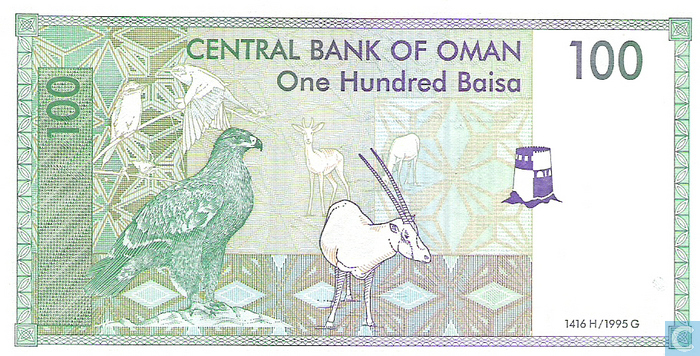
People in Oman are reminded everyday about steppe eagles because it appears on the back of the 100 baisa note along with the Arabian oryx, gazelle and bee eater.  I wonder who chose the steppe eagle as part of the design and why?

Image result for 100 baisa
The maps below shows what our radiotagged eagles are doing.  Since beginning of February, one eagle (105) has been moving around south of the mountains.  Until 13 February it was mostly near Al Mudaybi and Sinaw, often visiting the landfill there.  By the 15th it had moved west to near Al Ghafat, and during 19-24 February has been near Tawi Ajuz.

Movements of a steppe eagle (105) during 1-24 February 2017.
The other eagle (162312) also spent time near Al Mudaybi up until 1 February, then it made a big two day loop that took it south to a location abut 100 km SW of Qarn Alam, then up to a location about 40 km west of Adam.  On 4-5 February it was just west of Al Saleel Park, and since then it has been mostly at the Tahwa landfill that services Sur (although at times making excursions of up to 50 km or so).

Movement of a steppe eagle (162312) during 1-22 February 2017.


Thursday, February 2, 2017

Issues for large soaring birds

This blog post will not talk much about what the tagged birds are doing.  The vulture is mostly around the Tahwa Landfill site, one eagle is near Al Kamil and one is near Al Mudaybi.  You can look back at earlier posts to see some detail, and we'll post new information soon.  However, there are two items we wanted to bring to your attention:  soaring birds' collisions with aircraft and large birds' collision and electrocution at power lines in Sudan.

Many people are aware of the hazard that birds, especially large ones, pose to civilian and military aircraft, especially since that Tom Hanks movie:  "Sully".  Hollywood aside, birds strike is a huge problem that costs lots of money annually.  This is from Wikipedia:

The Federal Aviation Administration (FAA) in the US estimates bird strikes cost US aviation 400 million dollars annually and have resulted in over 200 worldwide deaths since 1988. In the United Kingdom, the Central Science Laboratory estimates that worldwide, the cost of birdstrikes to airlines is around US$1.2 billion annually.

Even if you quibble with the numbers, they are very large, and that does not even consider the worst part of "bird strike", which is the potential for humans to die or be injured in large numbers.

The point we are trying to make is that apart from the conservation value, better understanding of how soaring birds  (like the eagles and vulture we are tracking) move in the environment has huge benefits for human health (maybe outweighing the conservation benefit)!  If you want to read more then here is a link: http://wildlife.org/tagging-vultures-for-safetys-sake/


Results of a collision with a turkey vulture in USA. (photo from site mentioned above)
The second topic we want to remind you of is that large birds like vultures and eagles are at risk of electrocution and collision along power lines.  Even in Oman we know that some birds get electrocuted (though we don't know how many). Look back at the post for 21 December 2015. http://egyptianvultureoman.blogspot.co.at/2015_12_01_archive.html 

Sudan is one of the poorest countries in the world, and particularly dangerous power lines occur there, right in the area where many migratory and resident large birds live.  Have a look at this link:
http://www.birdlife.org/africa/news/how-many-more-killer-powerlines-are-there-sudan .  However... good for the Sudanese government!  Despite being poor and needing to supply electricity to many parts of a huge country, the Sudan has taken steps to address the problem.  Click on this link to see how they are trying to make the most dangerous power lines safe again.   http://lifeneophron.eu/en/news-view/187.html
Bird carcasses found along a stretch of power line in Sudan (photo from the site mentioned above)

Wednesday, February 1, 2017

Steppe Eagles - late January 2017

In mid January 2017 we caught two steppe eagles at Al Multaqaa landfill site, south of Muscat.  You can read more about that in an earlier post.  Since then, both birds have left Al Multaqaa and headed south.

The first bird we caught, "105" (an eagle hatched last year named after the ID number of its tag), stayed near Al Multaqaa and in the Wadi Sareen Nature Reserve for a couple of days, then headed south over the eastern Hajar Mountains.  Since then it has been mostly moving within about 20 km of Al Mudaybi, and making use of the rubbish dump there.

The second bird, "162312" (hatched in 2015) also stayed near Multaqaa for a couple of days then headed south to Al Qabil, then a location on the edge of the Wahiba Sands, then quickly on to the Tahwa landfill site south of Sur.  On 31 January it made a move back to the west and is currently about 20 km E of Al Mudaybi.

In the coming days I'll be providing more information on these birds and updating the information on the vulture we are tracking, so visit the blog again or follow us.  Remember, if you click on the image, it should open up larger in a new window.

Movements of two Steppe eagles fitted with satellite tags in mid January 2017  at Al Multaqaa Landfill